Showing posts with label Seasons - Summer. Show all posts

Thursday, June 20, 2013

THE SONG OF THE WITCHES ROUND THE WALNUT-TREE OF BENEVENTUM

An old poem that appeared in: BENTLEY'S MISCELLANY. VOL. XVII. (1845).
Shared by Raven Grimassi. Thanks Raven.
 
Hail to thee,
Weird walnut-tree!
All hail to thee ! all hail to thee !
We are come, we are come, we are come from afar,
By the glancing light of the shooting-star ;
Some from the south, and some from the north,
From the east, and the west, we are all come forth,—
Some o'er the land, and some o'er the sea.
To hold our sabbath 'neath the weird walnut-tree,
That tree of the awful and mystic spell,
Where we dance the roundels we love so well.
The gentle witch of Capua, who comes of a gentle kind,
Hath floated softly hither on the wings of the western wind ;
The gentle witch, whose witcheries the Capuan youth beguile,
With her arching brows, and her cherry lips, and'her everchanging smile :
But, though beauteous, and fair, and gentle she be,
She must come and bend to the weird walnut-tree.
And Medea is here from her Colchian home,
A dragon she rides through the white sea-foam.
Look at her eye with its cold blue glare ;
As lief rouse a lioness from her lair.
But, though murd'ress and fratricide she may be,
She must come and bend to the weird walnut-tree.
And who is the seer with the locks so white,
The wrinkled brow, and the eye so bright?
His tottering limbs have been hither borne
By a magic staff of the wild blackthorn,
And from Vetulonia'a halls wends he,
To come and bend to the weird walnut-tree.
Perimeda is here, with the golden hair,
Beauteous, and blooming, and buoyant, and fair;
She has come in a car drawn by peacocks three,
To bend at the shrme of the weird walnut-tree.
And the fairy Calypso has sped from her home ;
She has left her grotto and hyacinth flowers,—
Her fruit-trees, and birds that sing all the day long,—
Her gardens, and violet-scented bowers ;
In a nautilus-shell, so pearly and clear,
She has sailed from her isle in the Grecian Sea,
To join in our mystic roundels here,
And bend to the wondrous walnut-tree.
Hecate, hail! Hecate, hail!
Far hast thou travell'd o'er hill and dale;
By the dead man's tomb thou hast stopped to alight,
Where the Lemures gibber the livelong night,
And the ghoules eat the corpse by the wan moonlight,
For such arc the scenes where thou takest delight.
Hail to thee, Hecate, once and twice!
And hail to thee, Hecate ; hail to thee thrice!
The Queen of Hades' realm is here,
Bow to her, wizard, and witch, and seer!
But, though the Queen of Hades she be,
She must come and bend to the weird walnut-tree.
And Gerda has hurried from far Iceland,
She of the ruthless and red right-hand ;
A kraken has carried her o'er the sea,
To come and bend to the weird walnut.tree.
We are come, we are come, we are come from afar,
By the glancing light of the shooting star ;
Some from the south, and some from the north,
From the east and the west we are all come forth ,
Some o'er the land, and some o'er the sea,
To hold our sabbath 'neath the weird walnut-tree.
Then a song to the tree, the weird walnut-tree;
The king and the chief of trees is he ;
For, though ragged, and gnarl'd, and wither'd, and bare,
We bow the knee, and we offer the prayer
To the weird walnut-tree on the mystic night,
When we hold our sabbath 'neath the pale moonlight.
Hail to Taburnus. that mount of power,
And to Sabatus' stream in this witching hour !
And hail to the serpent who twines round the tree,
Whose age is known but to wizards three,
Who was brought from the land of ice and snow
By Saturn, in ages long, long ago,
And who sucks the blood of one of our band,
Whene'er 'neath the tree we take our stand.
Hail to them each, and hail to them all <.
Ho ! come with a whoop, and a shout, and a call!
Join hand in hand, and foot it full free,
Let us bound and dance round the walnut-tree.
Elelen ! Elelen ! Evoe ! Evoe !
For the witches who leap round the weird
walnut-tree.
C. H. L.

Tuesday, January 8, 2013

Can we talk about Global Warming now?

Information below taken from Wired.Com
Click the link for more information
http://www.wired.com/design/2013/01/australia-temperature-map/
"What happens when a changing climate exceeds the operating parameters of the stuff we own? While we in the northern hemisphere make jokes about indestructible snow forts, it is getting hot in Australia. How hot? So hot that Australia’s Bureau of Meteorology had to add new colors to its weather map. Now, those unfortunate parts of Australia that achieve temperatures above 122ºF (50ºC) — temperatures that were, until recently, literally off the scale — will be marked in deep purple and terrifying hot pink. It is an interesting moment in data visualization history when climate scientists find themselves in the position of revising the upper bounds of temperatures they ever expected to depict."

And if you think it can't happen here, Listen to this NPR Story.
"A brutal combination of a widespread drought and a mostly absent winter pushed the average annual U.S. temperature last year up to 55.32 degrees Fahrenheit, the government announced Tuesday. That's a full degree warmer than the old record set in 1998.
Breaking temperature records by an entire degree is unprecedented, scientists say. Normally, records are broken by a tenth of a degree or so."
And read more here.

Tuesday, June 19, 2012

"Early" Solstice

Feel the wheel turn.... be aware... so that you can learn from Nature.

http://www.hudsonvalleyalmanacweekly.com/2012/06/17/a-sooner-solstice/
Information below taken from the Link above:

This Wednesday, June 20, is the Solstice. It happens at 7:09 p.m. What’s so special about it? It’s the earliest summer since 1896: the earliest start of summer that you have ever experienced. Let’s see if the media pick up on this, or even realize it. So far as I know, it has not been published anywhere.
Anyway, summer: great. Bring it on.

Even in normal times, the Solstice is one of the few links between sky and Earth that’s popularly celebrated. Ask friends what happens and they’re likely to get it right, mostly. Longest day: check. Sun highest up: check. Sun moves through the sky along its most curving path: hmm, what? That one’s not widely known.

Still, people do pretty well with the Solstice. Yet most folks fail miserably when it comes to everything else about the sky. Even those with PhDs bomb when asked the stone-simple sky-stuff that every village idiot would have known 200 years ago. Go ahead: Test your friends. As the Sun is setting, does it move straight down, down and to the left, or down to the right? Most get this wrong. A century ago, everyone would have picked the latter choice without a moment’s hesitation.

Perhaps modern people are less observant. More finish college than ever before, but you don’t need a classroom to learn the basics of nature. It stares you in the face. But if you’re not looking, you won’t see it.

We could offer a hundred pages about the Solstice and its fascinating history, mythology and science, but let’s settle on ten goodies:
The word solstice comes from the two Latin words for “Sun” and “stoppage.” Makes sense: The Sun stops moving north that day.
The Solstice Sun hovers straight over the Tropic of Cancer, just south of Key West.
It’s when the Sun reaches its highest of the year, but it’s getting less high over time. That’s because Earth’s tilt is decreasing.
The Solstice is when the Sun is lowest in the sky for those at the Equator.
It arrives earlier as each century wears on. It’ll occur on June 19 in many places by century’s end. It was exclusively June 21 for all of our lives, until now.
In India, the Summer Solstice ends the six-month period when spiritual growth is supposedly easiest. Better hurry up and meditate (yes, that’s a joke): You’ve got less than a week left.
That day, the Sun rises farthest left on the horizon, and sets at its rightmost possible spot.
Sunlight strikes places in rooms that get illuminated at no other time.

In ancient Greece, the solstitial Sun happened in Cancer. But it has been in Gemini since around the time of Christ. In 1989 it shifted into Taurus, where it will remain until the fifth millennium.

But with all these goodies, the nicest fact may simply be that the Sun is now so wonderfully high. It’s 72 degrees up at 1 p.m., and won’t change much the next few weeks. It misses the zenith by a paltry 18 degrees. Look how short your shadow is.
With all that, given the world’s short attention span nowadays, TV announcers merely grant it two seconds: “It’s the start of summer!”

Saturday, August 13, 2011

Perfect Cornucopia Advice

Perfect Cornucopia advice... for your garden.... for your life...
What do you need? What is working? What is not? What will you keep? What will you eliminate?


Thank you Dan Gill.

Take stock of your landscape
Published: Thursday, August 11, 2011, 8:00 PM
By Dan Gill, Times-Picayune garden columnist NOLA.com


It's really too hot to do much of anything strenuous in the garden this time of the year.

I would certainly put off labor-intensive jobs such as creating new beds (or even reworking old beds), building structures like decks and arbors or major landscape plantings.

About all I feel like doing now is slowly strolling around my gardens in the early morning or late evening when the temperatures are somewhat cooler. Oh, I'll stop to take care of some weed issues (that never ends). Still, I try to keep the physical activity to a minimum. But, I'm not wasting time.

I'm doing three important things as I ramble around my landscape.

First, I'm enjoying it. I'm appreciating the beautiful flowers and bright colors of summer bedding plants and tropicals blooming this time of year. I'm sticking my nose into the flowers of butterfly ginger (Hedychium coronarium) and devouring the wonderful fragrance. You work hard to create and maintain your gardens -- don't forget to appreciate and enjoy them.

Second, I'm evaluating. I'm looking carefully at how well new plants are doing in this stressful late-summer weather. I'm also scrutinizing new plantings to see if plant and color combinations look as good in the garden as they did in my mind.

Finally, I'm re-evaluating my landscape. I tend to do this fairly constantly to some degree, but this time of the year I like to put a little extra thought into it. This is a good thing for everyone to do.

Why re-evaluate

As landscapes mature, things change. Trees get taller and cast deeper shade, and bushes can become overgrown.

People's lifestyles also change, and that area given over to a sandbox or a swing set may no longer be needed. Or you may have purchased an older home with mature plantings that no longer work well, or at least they don't satisfy you. Maybe the arrival of a new baby limits the amount of time you once had to maintain your gardens.

Whatever the reason, reevaluation is an important part of maintaining a landscape that is attractive and provides for the current needs of a family.

To start re-evaluating a landscape, you have to take a hard, honest look at what you have.

Changes in the garden can happen subtly over years, and you might overlook the obvious, such as an increase in shade or a physical change in your garden, unless you really focus.

Or, there are more sudden changes that haven't been properly integrated into the landscape. Maybe you added a deck, for instance, and traffic patterns have changed, but you haven't reworked the walkways.

Pretend you are the new owner of the house and garden you are surveying, and look at it with as much objectivity as you can.

Trees

One of the biggest changes that can creep up silently on a landscape over time is the growth of trees. They not only grow taller and larger, but they can dramatically influence what can or can't grow under or around them.

If your landscape has been planted for a number of years, you may find that some plants don't perform as well as they used to.

You might notice, for instance, that a bed of azaleas that has bloomed well for many years is no longer doing so, and the plants look leggy and thin. It could be that they need more light. Trees that were smaller when the azaleas were planted will grow larger over the years and cast more and deeper shade.

Lawns also often succumb to shade from a tree that has grown large over the years.

When shade makes existing plants grow poorly and look bad, consider removing those plants and replacing them with something more shade-tolerant. Plant areas where grass will not grow with shade-loving ground covers such as monkey grass or Asiatic jasmine.

In a few rare circumstances, you may decide that too many trees were planted in the landscape (easy to do, since trees are small when first planted). Sometimes it's necessary to make the difficult decision to remove a tree.

Shrubs

Overgrown shrubs can be trimmed back, trimmed up or removed entirely if no longer desirable.

It can be visually unattractive for a while, but a severe trimming can rejuvenate some types of old shrubs.

Hard pruning is best done just before shrubs start active growth. February or March is a good time to hard-prune shrubs that bloom in the summer. Prune spring-flowering shrubs in late March or April after they flower.

Once they begin growing again, you can control their size with regular pruning.

In other cases, if height is not an issue, you can trim a shrub up. To do this, selectively remove the lower branches of an overgrown shrub, training it into a small tree-form. This opens up space under and around the plant, making it less dominant.

Do you find yourself constantly pruning back shrubs that are too large for the area where they are planted? This is a fight you will never win. Often, removing and replacing these shrubs is the best idea. If you do decide to do this, make sure that you select new shrubs that will not grow too large for their location.

Planning ahead

The best time for planting hardy trees, shrubs ground covers and perennials in the landscape is November through March, with fall and early winter being best. That's why now is a good time to start doing this type of re-evaluation.

It gives you plenty of time to rethink your landscape and make plans for what needs to be done when the weather turns cooler.

And it's a great way to avoid working hard out in this hot weather, while still doing something important.

Wednesday, October 13, 2010

Elemental Solstice Prayer Alignment

“O spirits of the Elemental forces, hear me. And receive our blessings. O spirits of the earth. O powers that be, hear me and receive our blessings. Assist us on this sacred night to maintain the natural balance which keeps vital the essence of the earth. Let there always be clear flowing water, freshness in the air, fertility within the soil and abundant life within the world.”

These words are taken from Italian Witchcraft by Raven Grimassi. They are part of the Summer Solstice Ritual. But I think that they can and should be used more regularly to align our lives and our workings with Nature.

Sunday, August 1, 2010

Cornucopia

"Now hear the words of Aradia: "Know that every action brings forth another and that these actions are linked together through their natures. Therefore, whatsoever you send forth, so shall you receive. A farmer can harvest for himself no more than he plants. Therefore let us consider what is good in our lives and what is full. Let us also consider that is bad and what is empty. And let us meditate upon the reasons for all of these things."
Taken from the Cornucopia Ritual in "Hereditary Witchcraft" by Raven Grimassi

Lots of folks think of Cornucopia as a celebration of aubundance, a harvest festival.
And there is that aspect to the holiday.
But there is more to it than that.

Now is the time to take stock of your life and determine
what is good and to take the time to be thankful for the blessings and abundance in your life
AND
what is bad and empty or not so good and think about why this is and meditate on what you should do about it.

Anyone who gardens will understand the need to review what plants are "working" in the garden and what plants are not.
Sometimes a plant doesn't work because it doesn't grow well in the location. Maybe all it needs is to be moved to a new spot.
Sometimes a plant doesn't work in the garden because it grows too well and begins to take over and leaves no room for others.
Sometimes a plant is just not hardy in the enivornment and needs to be removed.


As Streghe this is the time of year we assess our lives and take time to make the decisions and to enlist the Gods as necessary to make changes.

Tuesday, June 1, 2010

Summer Dress

Taken directly from Internatinal House New Orleans

For generations New Orleanians have upheld the tradition of altering their homes for summer and winter in response to climactic conditions. As winter gives way to summer, wool gives way to sisal rugs and cotton slip covers, which allow furnishings to breathe during the months of heat and humidity found in this semi-tropical climate.

With the advent of summer, International House enters the season with a change of light, design and rituals. In an effort to fulfill this hope, International House transforms its lobby by dressing it for summer and the more relaxed, languid lifestyle, which accompanies it. Guests will discover cotton slipcovers with mocha piping on the furniture and sisal rugs in place of formal upholstery and throw rugs. Likewise, the lobby is accessorized with indigenous banana leaves, palms, fragrant floating blossoms and spiraling topiary. This soothing, relaxing environment is sure to induce most guests to spend at least a portion of their day happily lounging. International House not only looks outwardly to create the ambiance within, but also inwardly with the furnishings designed by local artisans.

In keeping with this time, staff members add to the mix by dressing in taupe and cream colored seersucker suits, which may be recognized as a sartorial statement honored by most New Orleanians. Seersucker is arguably the most unique fashion statement in the city. It is common to see a veritable pilgrimage of businessmen dressed in the more traditional blue and white seersucker meandering around CBD streets at lunchtime.

Guests may discover the depth, diversity and beauty of celebrated traditions related to African-American and folk communities. Beautifully, they have given us jazz, ragtime and blues music. They have given us that rich culinary delight which is Creole cooking and they have provided us with intriguing days of observance, rooted rituals known to locals International House proudly shares these celebrations with their guests. Whether it is the RaRa festival on April 2, or a festival steeped in Voodoo lore, St. John's Eve, June 24, or Louis Armstrong's Birthday, July 14, guests can peer into these longstanding rituals. Each night, a hotel staff member places a "picayune card" at each bedside to not only wish pleasant dreams and a good night's rest but to explain the current ritual. It is not uncommon to stumble upon a jazz funeral with its famed second-line or spontaneous parade of the Mardi Gras Indians.

Sunday, August 16, 2009

Seasonal shift

I know, right now in other parts of the country and northern hemisphere this is prime summer growing season. I live in New Orleans which has and I hope always will be slightly out of phase with the rest of the world. Now is the start of our inbetween season. Watermelons are ready and the okra is going crazy. But many summer plants are finishing up. Oh the eggplant and peppers will produce into the fall but it is time to think about pulling up the tomato plants. We can start harvesting and keep harvesting basil for pesto until the first frost. But the basil is at its prime now. It is also time to think about planting our fall crops.

While this process can seem wildly out of phase with other parts of our county it is in keeping with the mythos that is part of my tradition. Autumn Equinox is when our God dies. Here in New Orleans we start to see the signs earlier than most. It actually makes sense with our agricultural seasons for the God to die and go into the earth at the equinox. Seed crops like sugar snap peas, dill and root crops like onions, leek, radish, carrot are what we'll plant. We can plant other crops too like kale and parsley.

One of the things that I love about my tradition's wheel of the year is that it works with what passes as seasons here in New Orleans. This year I've decided to go with organic heriloom seeds instead of seed packs from Lowe's or Home Depot. I've placed the seed orders today. The seeds should be here in a week or 2.

Monday, August 10, 2009

Festival of Diana - August 13

Take a walk into Lake Nemi as CMC Green, the author of Roman Religion and the Cult of Diana at Aricia describes the setting:
"From here (the narrow road to the crater) the road curves, cresting the crater's ridge, and one finds oneself in a world of incredible remoteness and indeed, sacredness, even while the noise of school children playing has not yet died away. ...

Within the crater the woods are thick and green and birdsong fills the air, and the perfect blue of the lake reflects the sky and the crater's sloping sides. The old (asphalted) Roman road, still slopes gently down from the crest to skirt the lake, moving away toward the sanctuary at a point where the lake leaves a blunt triangle. To pass over the ridge into the crater is a very real experience of crossing a boundary into what is still effectively sacred space.

The crater is steep and the lake 30 meters deep, with only a narrow shoreline. On the northeast side is the one bit of level land beside the lake, roughly triangular in shape. ... Just to the east beneath the sheerest rise of stone, a great spring poured from the crater wall and into the lake. ... The crater is large enough to define a world of its own but not so large that it invites fragmentation of its interior space and in this very contained space, the triangular flatland forms a single orienting point.

The crater is the natural place for a hunting cult. It is the universe writ small, uniting the three cosmic levels - the earth, the canopy of the heavens, and, through the depths of the lake and the caves at its shore, the underworld. It was then, as now, a place of stunning beauty and peace, sacred and remote. ...

It is a small lake, spring fed, ... As there was no above-ground outlet, the lake level would have changed according to seasonal rain or drought although over time such changes would be modertated by the underground outflows. ... This triangle, broad across the curve of the lake and narrowing into the crater walls, is where the terrace for the lower sanctuary was eventually built. It resembled the stubby handle embracing the bottom of an Etruscan mirror. On a calm day the lake reflects the sky and the shoreline with shimmering perfection. The Romans, much more attuned to the visual impact of the setting than we can be, called the lake the speclum Dianae.

The crater has its own microclimate. Violent thunderstorms, earthquakes and thick fogs are all more frequent there then they are in the plains of Latium beyond. Trees - today chestnuts but in antiquity also beech and oak - as well as scrub and the larger woody bushes grew thick on the crater slopes: the area was densely populated with wildlife."

Imagine the ancient celebration as described by Ovid, from his Fasti:
In the Arician valley, there is a lake surrounded by shady forests,
Held sacred by a religion from the olden times...
On a long fence hang many pieces of woven thread,
and many tablets are placed there
as grateful gifts to the Goddess.
Often does a woman whose prayers Diana answered,
With a wreath of flowers crowning her head,
Walk from Rome carrying a burning torch...
There a stream flows down gurgling from its rocky bed..."

One Roman poet, Propertius, apparently attended the festival in the 1st century CE, as indicated in these words to his beloved:
"Ah, if you would only walk here in your leisure hours.
But we cannot meet today,
When I see you hurrying in excitement with a burning torch
To the grove of Nemi where you
Bear light in honour of the Goddess Diana"

Saturday, August 1, 2009

Cornucopia

August 2nd is Cornucopia. It is the time when Streghe celebrate and give thanks for the gifts of the harvest. Also, most appropriately, the following week is (only the 2nd ever) National Farmer's Market Week. So get out and celebrate the gifts of the harvest by visiting a local Farmer's Market.

We are physical beings so we can and should learn from and appreciate the physical. But all of our Treguenda have spiritual elements. This is the time when we review our lives and look for what can be harvested and appreciated and what should be weeded and removed.

As the words from the ritual say:
"Now hear the words of Arardia: 'Know that every action brings forth another, and that these actions are linked together through their natures. Therefore, whatsoever you send forth, so shall you receive. A farmer can harvest for himself no more than he plants. Therefore, let us consider what is good in our lives, and what is full. Let us also consider what is bad and what is empty. And let us meditate upon the reasons for all of these things."
Taken from Raven Grimassi's 'Ways of the Strega', republished as "Italian Witchcraft".

So take some time to enjoy the harvest and reassess your life. By doing this you are aligning yourself with the energies of the Wheel of the Year.

Sunday, July 19, 2009

Queen of the Night - Cestrum Nocturnum

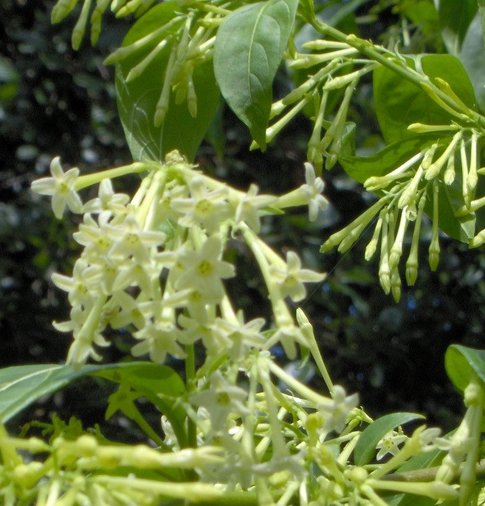
Of course, just after I finish my post on Summer Shrine Offerings, the Queen of the Night starts blooming like crazy. This plant has such a heady scent, especially in the evening when the flowers open, that it can cause repiratory issues in some folks. Thankfully it does not affect me or my family or my neighbors in this fashion. The clusters of star shaped flowers makes this plant a perfect Lasa offering. The white flowers blooming in the night make it a great Goddess offering. The shape of the closed flowers make it work as a God offering. Just as the scent draws neighbors and visitors to try and find the plant, I can imagine it drawing in the Gods.

The flowers remain closed during the day. One cluster was "working late today" so I was able to get a picture.
Queen of the Night - Flowers & Buds Close up

The plant is a postKatrina volunteer. And we are grateful for it, just as we are all the postKatrina volunteers who have given us so much.

Wednesday, July 15, 2009

Shrine Offerings - Plants & Flowers

It's summer, deep hot summer. During the cooler months it is easy to find offerings for my Lasa/Lare Shrine and God & Goddess Shrines. But in the deep hot summer, it's not so easy. I like flowers as part of my offerings but it has been my experience is that scent is an important part of the offering, it pleases the spirits. So plants with aroma, primarily herbs, are what I have focused on growing.

One plant that actually produces flowers better in the heat than in the cooler times of year is Pentas. These bushy plants have large flower clusters and the flowers come in pink, red, white, purple. The only color I haven't seen is yellow. I like the many 5 petaled flowers, because they remind me of the pentacle and stars which I associated with the Grigori. In many ways the Grigori are like Lare who watch over all Streghe. I tend to use these flowers more in my Lasa Shrine but have also used them in my God & Goddess offerings when other offerings aren't as readily available.

My yellow Shrimp Plant is also a consistent flower producer in the summer months. I use it's flowers almost exclusively on my God Shrine.

Zinnias tend to do well in the heat and make great cut flowers. My problem has been in getting them to consistently grow from seed. I did manage to ge a few this year. I'm beginning to think this was because we had a very dry early to midsummer. I'm going to try again next year and water the seedlings less and see if I can be as successful. Zinnias work well for Lasa, God & Goddess offerings. I tend to use the orange & yellows in the God offerings, pinks for the Goddess and purple for the Lasa.

Many roses stop blooming in our summer heat. The exception is the Europeana Rose. I've never seen anything like it. It literally blooms year round, not as prolifically in the summer, but it still blooms. Additionally, unlike many modern hybrids, it also smells like a rose. I'm working on growing more via layering because this rose is so fantastic in our summer heat. Roses work as offerings for the Lasa, Goddess & God and when there are lots of Roses I'll use them in all 3 offerings. But when there are fewer roses I confess I tend to use it more on my Goddess Shrine.

Another herb that offers its white flowers in the summer is Greek Oregano. This plant is hardy and heat tolerant. It leafs out in the spring and by midsummer has begun to flower. After it flowers I cut it back in the last summer and dry it to use in cooking and the remaingin naked sticks go into fall bonfires. Like all the other herbs its scent is part of the offering. Once the scent is gone from any herbal offering it is time to replace with something new.

My spearmint is beautiful in the spring with its lush deep green leaves. The smell is heavenly. I use it as a ground cover so that I can step on it on purpose and release the scent. But do not plant mint unless you are willing to let it run. You can not easily contain it. Even when planted in pots if these pots are on the ground in a gardent the mint manages to escape and spread. As the heat of summer progresses it puts out white flowers shaped appropropriately like a a spear tip. In late summer first the leaves and then the flowers begin to die back. I use the mint leaves in the spring and the flowers in the summer and then in August I will cut it back hard and save the cuttings for fall bonfires. Mint can be used on as offerings for the Lasa/Lare as well as the God & Goddess Shrines. The spear shape works for the God. The white flower looks great in all white flower (mint, oregano, white pentas, rose if I'm lucky) Goddess Offerings. The leaves and flowers and the heady scent work in the Lasa Shrine.

Pennyroyal is another mint that grows well in the south. In the summer it blooms lovely clusters of purple flowers along its rambling tendrils. It works especially well for me in my Lasa shrine. It is also great as a flea repelent on pets. Break some of the runners of of the plant and rub it down your pet's back. Pyrethrin is a key ingredient in many flea soaps and comes from pennyroyal. This doesn't seem to affect the Lasa at all. They seem to enjoy the small globe clusters of flowers and the scent.

In the summer I can count on Russian Sage . I planted this looking for a purple flower that could stand the heat. The plant can stand the heat but I rarely get the lovely purple flowers. It does however have a strong sage scent.
I also have cooking sage as long as I keep it in the shade under our Bradford pear tree. The Lasa dislike sage and it doesn't seem to work well for the Goddess either, so I use it only on my God Shrine.

Spanish Tarragon is a wonderful addition to deep south gardens. It blooms happy yellow flowers late in the season. I like to use the yellow flowers for the God Shrine. The scented leaves work also work well for the Lasa & the Goddess. I've tried to grow French Tarragon but I've not been successful, yet.

Lavender blooms in the spring, but the leafy plant can be used all year round. I just have to cut offerings more sparingly in the summer as the plant doesn't grow as fast nor is it as hardy in the heat of the year. I have a number of different types of Lavender. Sweet Lavender with its tall flowering spikes is great in the spring but it is the Allardi Lavender that I can count on for fragrant leafy offerings in the summer. Spanish Lavender & French or Denticulated Lavender seems to be most sensitive to our Gulf Coast climate changes. I typically reserve Lavender as offerings for the Lasa & the Goddess. The greyish tint of the Allardi Lavender leaves goes well with the all white full moon Goddess offerings.

I can grow Fennel easily from seed. Once established this plant can last 2 or more seasons. Fennel is extremely connected to the Lasa and Fata. As an offering in the vase on my Lasa Shrine, nothing seems to make them happier. The fennel has a nice licorice aroma and the delicate fronds create a soft comfortable environment in the vase. I haven't been successful in growing stalk fennel but have been highly successful with "bulb" fennel. In the Mediterranean California climate fennel grows wild along the coast and is perfect for the type of stalks necessary for the Summer Solstice ritual.

I'm also trying to grow asparagus. And while we've had only a few tasty asparagus shoots, the plant makes frondy, frilly offerings that are great in the Lasa shrine or as fill in God or Goddess offerings. Cutting back the plant also encourages root growth which is just what I need.

Basil is a strong summer plant in New Orleans. It must be planted in spring when the weather is cool but thrives in the summer heat. Its fragrant green leaves can be used as offerings. But so can any flowers. The Basil plant will weaken once it starts to flower because it's thinking about creating seeds. So cutting the flowers from basil plants helps them grow more leaves and stay strong. We can harvest basil for offerings and cooking all summer but have to make sure that we harvest most of the plant before the first frost. So pesto is often a home made Solstice/Christmas gift from our house. Thai Basil or Queen of Siam Basil or Cinnamon Basil flowers added to vinger create a flowery pink tinted vinger that is also good as a homemade gift. When you open a bottle of Cinnamon Basil Flower vinegar in the winter brings the smell of summer flowers into the room.

When I am placing offerings in my 3 shrines I like to use one herb or flower to "connect" the offerings on all 3 shrines: Lasa, Goddess, God. So I might have Fennel and Pentas in the Lasa Shrine. Roses and Lavender, with a sprig of fennel in the Goddess shrine. Tarragon flowers & Russian Sage, with a sprig of fennel in the God Shrine. I keep my offerings in small vases and change them regularly.

Thursday, July 9, 2009

Pines of Rome

Pines have a special place in my memory. While I am a native New Orleanian, my father's family was from the Mississippi Gulf Coast. We spent our weekends in the pines, along the railroad tracks picking blackberries, or on the sandy beaches in the shallow waters of the Mississippi Sound. I remember holding the lantern in one hand and my dad's hand in the other and shuffling my feet just right so the sting rays wouldn't get me and so I wouldn't scare off the flounders he was gigging; or being up in the predawn, with my mom & grandmother preparing for a morning of crabbing on the seawall, with crabs for dinner and sugared blackberries and cream for dessert. After dessert we'd go out in the clearing on the edge of the pine trees and marvel at the night sky and the Milky Way and the fire flys and the satelites which were always called Sputnik even though Sputnik had been out of the sky for years before I was born. New Orleans and the Mississippi Gulf Coast has had a link to Space Manufacturing. People know about Houston & Florida but forget about the other space worker bees in on the Gulf Coast at Michoud & Stennis. After Hurricane Camille there were many large, 3 to 4 feet in diameter, trees down on my grandparent's land and the surrounding land. These were eventually harvested by loggers and helped pay recovery costs for my grandparents and others after the storm. But not right away, we had almost a year of being able to play in the downed trees. Trees that were formerly just rough bark with unreachable tops were suddenly our own jumbled world of pine & oak pickup sticks, our play ground. We could walk the trunks like bridges and jump from tree to tree. It was like being in the tree tops. And the resinous pine sap smell was stronger than ever. We always went home sticky, exhausted, exhilarated.

Featured in Walt Disney's Fantasia 2000, the Pines of Rome is beautiful and haunting and written by Italian Ottorino Respighi. Today is his birthday. It was only on future research that I discovered that the Pines of Rome is actually part of Respighi's Roman Trilogy, three symphonic poems evoking Roman places and times of day. The first in the orchestral trilogy is the Fountains of Rome, the second is the Pines of Rome and the third is Roman Festivals.

Fontane di Roma (Fountains of Rome) (1915-1916)
Taken from Wikipedia with slight modifications
The first movement, "La fontana di Valle Giulia all'Alba" , shows this fountain at daybreak in a pastoral landscape, in which cattle pass during the morning. The fountain is not actually in Rome but in the countryside surrounding it. In the second movement - "La fontana del Tritone al mattino" - Naiads and Tritons dancing in the morning light, as figures of the Bernini fountain are seen nearby. Gods and goddesses using conch shells are portrayed by the French horn. The third introduces "La fontana di Trevi al meriggio" and is ushered in by a triumph giving news of a recent victory by the god Neptune shining in the noon light. The final movement, "La fontana di Villa Medici al tramonto", gives a much more melancholic atmosphere, as the brilliance of the sun fades.

Pini di Roma (Pines of Rome) (1923-1924)
Taken from Wikipedia with slight modifications
Each movement portrays the location of pine trees in the city during different parts of the day. The first movement, called "I pini di Villa Borghese", portrays children marching and playing in the pine groves of the Borghese gardens. The second movement, "Pini presso una catacomba" has a more melancholic tune, representing pine trees close to a catacomb in Campagna. The third part, a nocturne, "I pini del Gianicolo", is set at night, near a temple of the Roman god Janus on the Janiculum hill. Double-faced gods open large doors and gates, marking the beginning of a new year. A nightingale is heard, giving Respighi the opportunity to include real life bird sounds in his work, a feat unachieved before (the score mentions a specific recording that can be played on a phonograph: the Brunswick Panatrope). The final movement, "I pini della Via Appia", portrays pine trees along the great Appian Way. Misty dawn: a legion advances along the Via Appia in the brilliance of the newly-risen sun. The grounds trembles under the footsteps of his army and the consular army rises in triumph to the Capitoline Hill. I could link you to pictures on the web but think its better if you listen and let the music paint pictures for you.

Feste Romane (Roman Festivals) (1928)
Taken from Wikipedia with slight modifications
This is the longest of the trilogy and depicts scenes from Ancient Rome of the Roman Empire. It is also the least known of the three. Within the first movement called Circenses or Circuses, the music presents the theme of an ancient contest in which gladiators battle to the death. Next, the Gubileo, or Jubilee, portrays the fiftieth year of festivals in Roman tradition. Pilgrims approach Rome catching a breath-taking view from Mt. Mario, as church bells ring in the background. L’Ottobrata, or the Harvest of October, represents the harvest and hunt in Rome. The final movement, called La Befana, or the Epiphany, takes place in the Piazza Navona and depicts Roman songs and dances, including a drunken reveler.

Monday, June 15, 2009

Hot times in the City

It's has been a while since I last posted on this blog. I am also a neighborhood activist in the PostKatrina World, wife, mom, fulltime professional for a big corporation and sometimes pagan blogging has to take a back seat.

We had a marvelously cool spring and early summer. This is practically miraculous.

The school year is out and my husband and daughter are both home from school, him from teaching and her from 7th grade. We are thankful for friends with swimming pools and for dark cool theatres. I've always thought that our theatre season should be the summer because of the appeal of dark, cool theatres. This weekend we went to 2 plays (a premier & Shakespeare), as well as seeing the classic CasaBlanca on the big screen at a 1915 movie theatre. It's important to teach the kid "cultural literacy". We also saw CarrotBlanca with Bug's Bunny and a cast of old Looney Tunes characters, which made me think about how much of my own cultural literacy can be attributed to Loony Tunes & the creative genius of Mel Blanc & Warner Bros. But I digress.

Summer is our harsh season. In other parts of the country and world the winter season is the harshest season, the season where folks prepare to go outside and say WHEW! when they finally get inside. In New Orleans we prepare for a summer's day the way folks in Maine prepare for a walk in the woods in January. If there are outside chores it is best to do these before 10AM. You want to be inside, cooled off, showered and with a cold drink by 10:30AM. Then you wait out the heat of the day, until the evening. The evening is that short time between when the heat has begun to dissipate and before the mosquitoes come out to carry you away.

Because of how my house sits on its lot, I need to be out working in the front yard at daybreak and done as early as possible. I can then move to my back yard where the house shields the back patio for an hour or so more. Then I have to hide out in the shade or indoors until later in the evening. If I absolutely HAVE to do front yard work in the summer, then sometimes I can get a hour in after 5PM when the front yard is mostly shaded.

We don't live in the desert BUT, in New Orleans, we do completely respect the sun's power. This is why music gigs in New Orleans rarely start before 10PM. It is just too hot to go out before then! I'm also a believer in early rising and after lunch naps whenever possible in the summer. Siesta time makes a large amount of sense in the heat. And summer is when I remember that shade trees are a true gift from the Gods!

It has always bugged me that the Summer Solstice is called by many "the first day of Summer" when in reality it is "MidSummer", or Summer's turning point, well for most places. In New Orleans it is officially summer on the first day that the temperature hits 90 degrees. This happened this year in early May but then we got another reprieve of days that were in the 70s & 80s. So we are practically spoiled now that it hits 90 degrees or better everyday and probably will until September or October. The Autumn Equinox is a marker that allows us to hope that the heat will break but it doesn't typically mark any true change in the basic summer weather patterns. This is also why the hurricane season doesn't end until November.

How many people do you know who consider Air Conditioning as a productivity tool? It is here. It can also cut people off from the seasons and the earth. When you are cocooned inside your totally climate controlled house & car you can definitely loose connection to the greater world. Sometimes I think if there were no A/C that a lot more people would be taking climate change seriously. When you step out on to your porch and the heat and humidity punch you in the nose, you learn to respect it.

So if Summer is not your harsh season be thankful and get out and appreciate it!